How Social Casino Games Work—and How They Make Money—in 2026
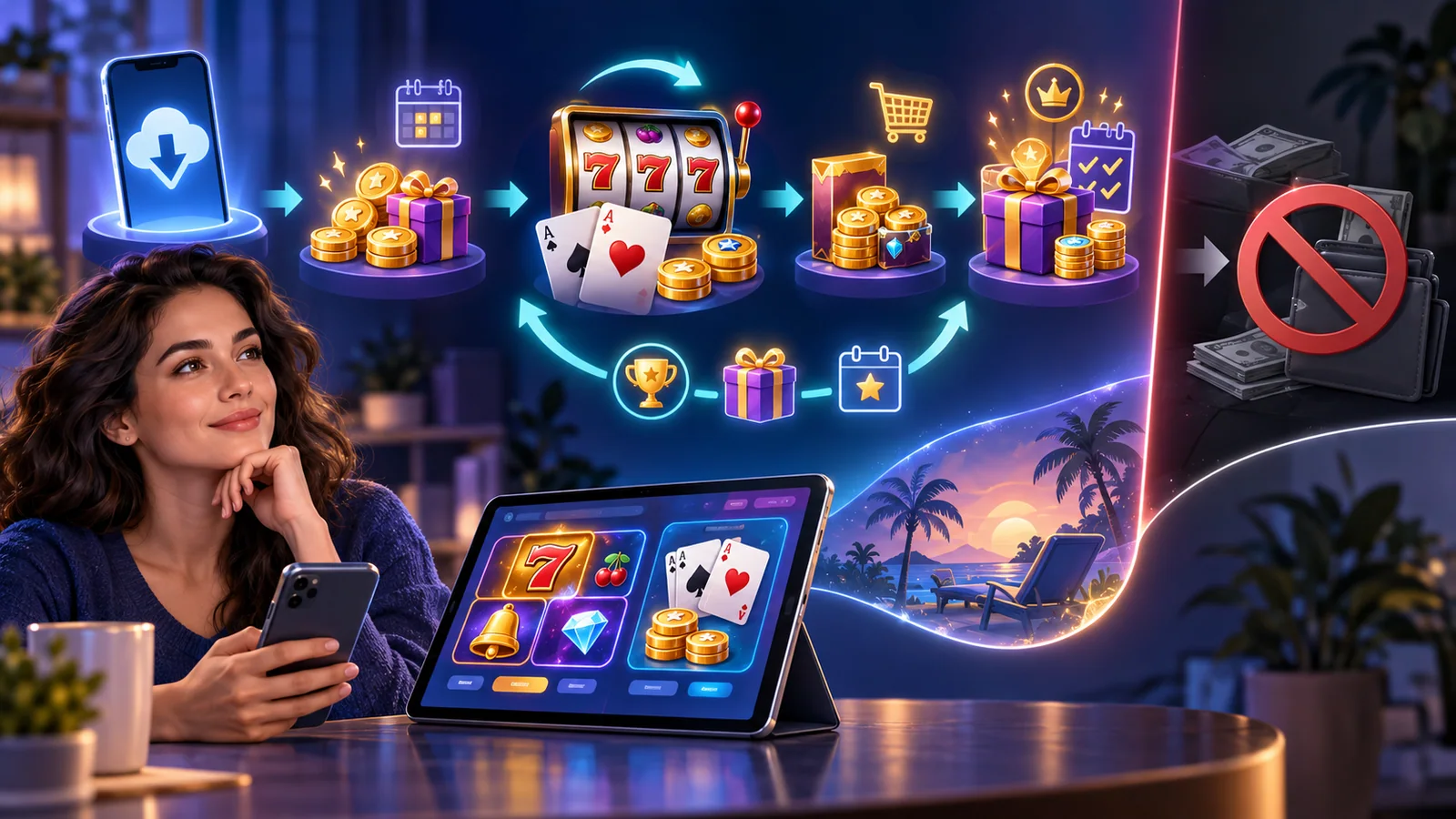
Image: Lophy
Social casino games borrow the loops and presentation of slots, poker, bingo, and table games. The cleanest play-money versions award virtual currency that cannot be redeemed for real-world value. But the category also sits beside sweepstakes and regulated gambling products, so one slogan cannot describe every app.
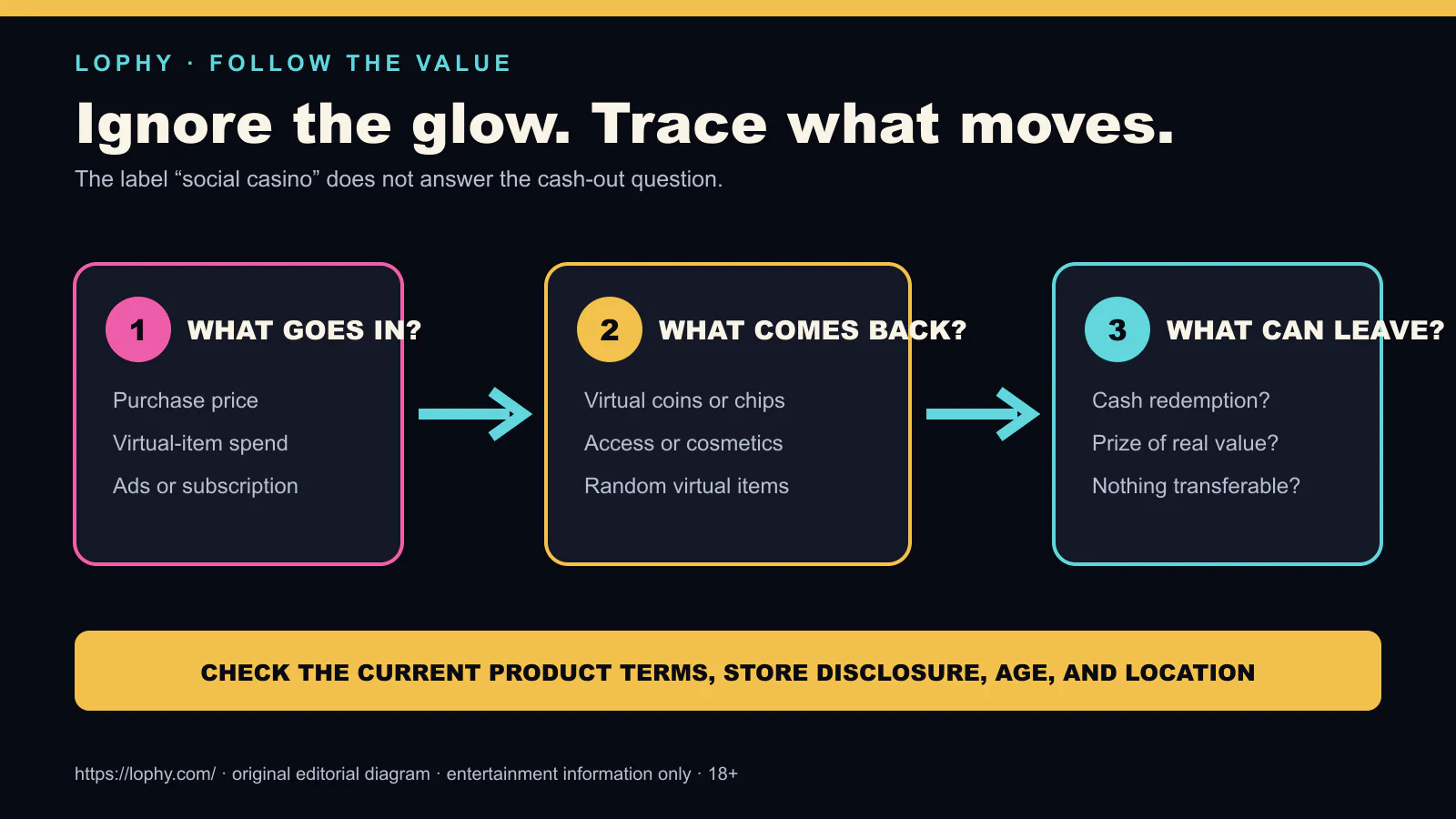
Here is the useful test: ignore the artwork and follow the value.
Step 1: follow what goes in
A game may be free to install while charging for:
- virtual coins or chips;
- random virtual items;
- subscriptions or passes;
- event access or convenience features;
- ad-free play;
- cosmetic collections.
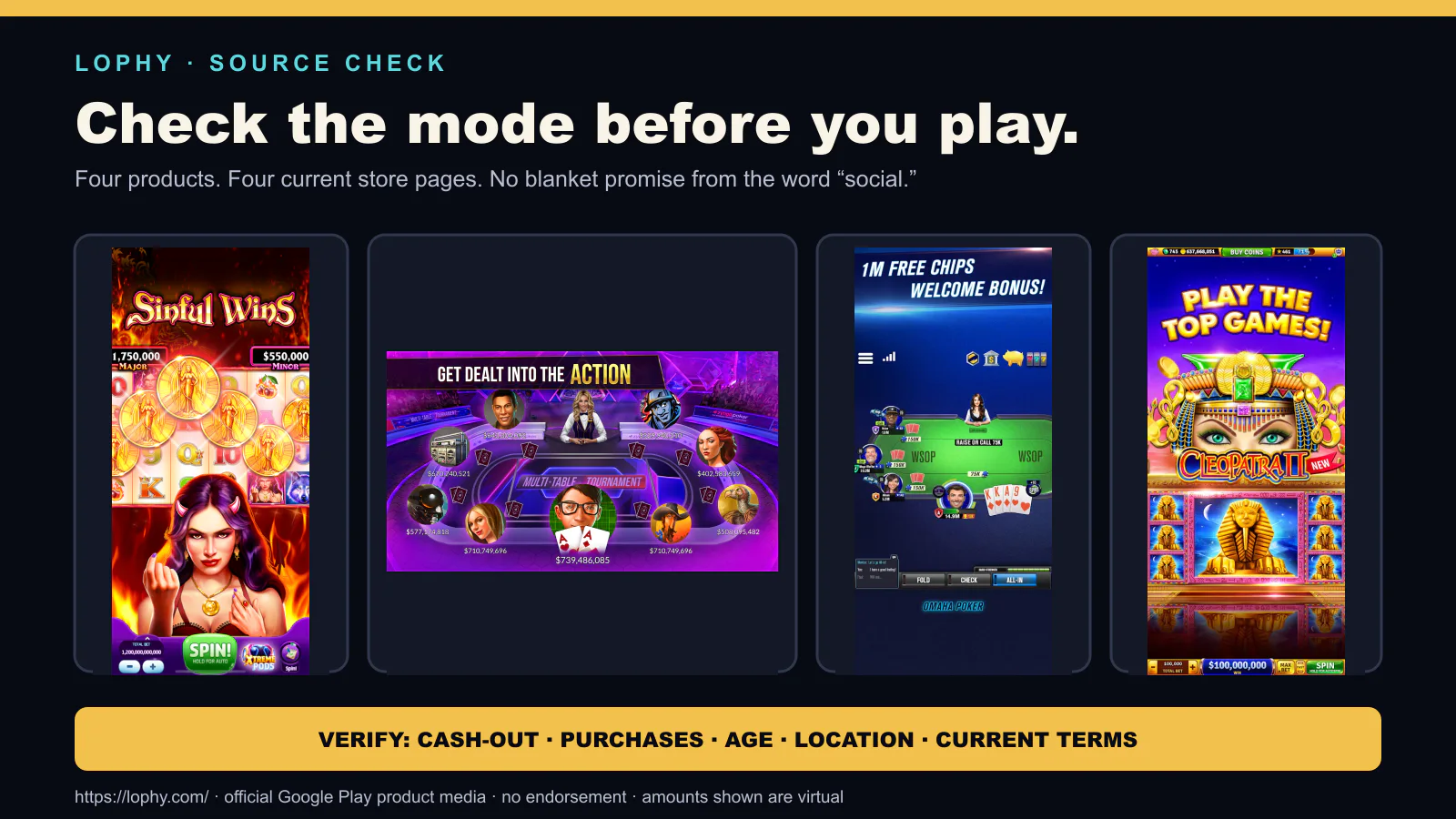
Current Google Play listings for Slotomania, Zynga Poker, WSOP Poker, and House of Fun all disclose in-app purchases; several explicitly disclose random items. “Optional” is accurate, but it does not mean pressure-free.
Step 2: follow what can come out
Ask whether any coin, token, prize, gift card, merchandise award, or account benefit can be:
- redeemed by the operator;
- transferred to another user;
- sold or exchanged;
- used to enter a prize-bearing promotion;
- converted into cash or something else of value.
If the answer is no, the product may be a conventional play-money game. If the answer is yes—or there are “sweeps coins,” prize-redemption rules, mail-in entry, or geographic eligibility—the product needs a different analysis. Read the official rules and the law where you are. This article is not a legal classification of a particular game.
Step 3: understand the virtual-currency licence
Virtual chips often look like a balance, but the terms may define them as a limited licence rather than property or stored money. PokerStars, for example, says its play-money virtual items do not create a real-world balance or title in the items.
That protects the distinction from cash, but it does not refund the money used to buy virtual items. Read expiration, account-closure, refund, transfer, and dispute terms before purchasing.
How the design earns
| Mechanism | What the player gives | What the product returns |
|---|---|---|
| Virtual-item purchase | Money | More in-game currency or content |
| Advertising | Attention and sometimes data | Access or a virtual reward |
| Subscription/pass | Recurring payment | Periodic features or rewards |
| Timed event | Time, and sometimes money | Progress, status, or virtual items |
The loop often uses countdowns, streaks, scarcity, celebratory effects, and repeated purchase prompts. The FTC’s dark-pattern report documents how interface design can steer users toward purchases or make a free version intentionally cumbersome. That does not prove every game uses a prohibited practice; it gives players a checklist for evaluating the interface in front of them.
Why play money can still cost real money
A non-redeemable virtual coin may not be a cash wager, but buying it still spends real money. The user can also face subscription renewals, accidental purchases, privacy tradeoffs, and high-pressure offers.
The accurate promise is narrower: in a verified play-money mode, game winnings may have no cash value. That is different from saying the experience cannot cost money or cause harm.
The five-minute safety setup
- Confirm the publisher and official store page.
- Read the current terms, prize rules, and age rating for your location.
- Disable or password-protect in-app purchases.
- Turn off marketing notifications and review subscription renewal.
- Set both a spending cap and a time cap.
Sources
- Google Play policy: real-money gambling, games, and contests
- Apple App Review Guidelines: gaming, gambling, and lotteries
- FTC: Bringing Dark Patterns to Light
- PokerStars: terms for play-money virtual items
- Google Play: Slotomania
Source check: 27 July 2026.
social casinohow it worksfree-to-playplay-moneyexplainer